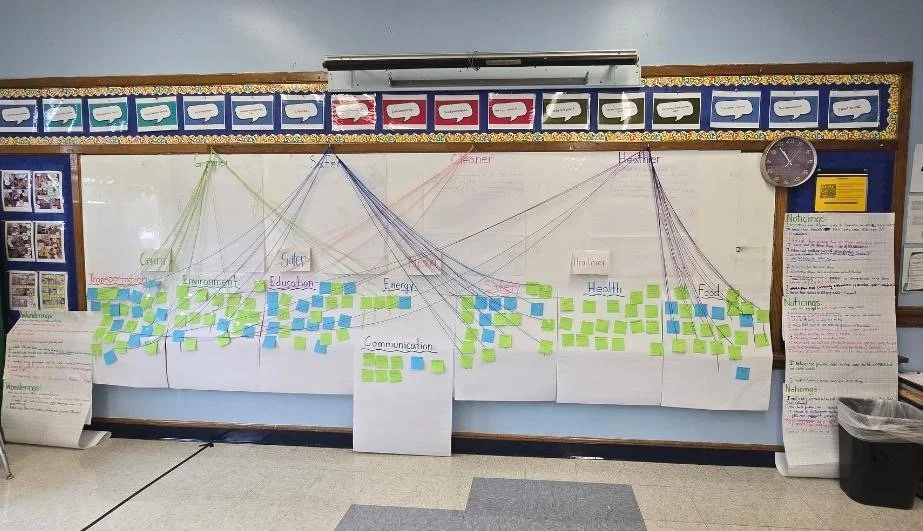
The Research
“Place-based pedagogies are needed so that the education of citizens might have some direct bearing on the well-being of the social and ecological places people actually inhabit.”
— David A. Gruenewald (2003)
Research Base
This project is grounded in the belief that mathematics is not neutral. Mathematics education reflects what a society values, whose knowledge is centered, and what kinds of participation students are invited into. Traditional approaches to mathematics often position the subject as abstract, universal, and disconnected from culture or place. In contrast, critical and place-based approaches frame mathematics as a human practice shaped by power, identity, community, emotion, belonging, and lived experience.
A Critical Pedagogy of Place
David Gruenewald’s concept of a critical pedagogy of place provides a central framework for this project. Gruenewald argues that critical pedagogy and place-based education are mutually supportive traditions. Critical pedagogy asks learners to examine power, injustice, and dominant assumptions. Place-based education asks learners to engage deeply with the social and ecological places they inhabit. Together, these traditions invite students to understand place as both lived and political.
Gruenewald identifies two interrelated goals: decolonization and reinhabitation. Decolonization involves questioning dominant narratives, histories, and systems that disconnect people from place and community. Reinhabitation involves learning to live well in places that have been disrupted, neglected, or injured. In this curriculum, students engaged both goals by using mathematics to examine Orange, identify community needs, and design more sustainable possibilities.
Mathematics as Civic, Emotional, and Identity Work
The project also draws from critical mathematics education, culturally relevant pedagogy, research on mathematical belonging, and brain-based work on math identity. These frameworks challenge the idea that mathematics is only about computation or correctness. Instead, they position mathematics as a way to analyze systems, make decisions, communicate evidence, participate in civic life, and develop a stronger sense of oneself as a capable mathematical thinker.
This matters because students’ mathematical identities are shaped by the opportunities they receive to think, contribute, explain, revise, and be seen as capable. When students use mathematics to investigate issues that matter to their lives and community, they are more likely to experience the subject as purposeful. Flavin and Flavin’s work on speculative design and mathematical modeling is especially relevant here because it connects mathematical modeling to students’ capacity to imagine and articulate possible futures for their communities. Their framing of belonging, drawing on Good et al. (2012) and Barbieri and Miller-Cotto (2021), reinforces that students need to feel accepted, valued, and represented within mathematics in order to participate fully in the field.
Liesl McConchie’s brain-based work further strengthens this argument. Her assertion that “a student’s emotional relationship with math is foundational to their cognitive relationship with math” positions emotion, identity, and belonging as central to learning, not separate from it. In this curriculum, students’ emotional and cognitive relationships with mathematics were developed together as they used data, scale, proportional reasoning, geometry, and design to investigate Orange, New Jersey, and imagine more sustainable possibilities.
In this curriculum, students were positioned not only as learners of mathematics, but as researchers, designers, civic thinkers, and community problem-solvers.
Place-Based Mathematics Education (PBME)
Historically, place-based mathematics education emerged as a response to decontextualized and standardized mathematics instruction. Rather than treating mathematics as separate from the world, place-based mathematics asks students to find the mathematics embedded in local land, culture, systems, and community questions. Over time, this approach has evolved from environmental and rural roots toward more critical, urban, justice-oriented, and sustainability-centered applications.
This project builds on that evolution. Students used mathematics not only to analyze problems, but to propose solutions. Their work connected proportional reasoning, scale, data analysis, measurement, geometry, and design thinking to questions of sustainability, equity, belonging, and community well-being.
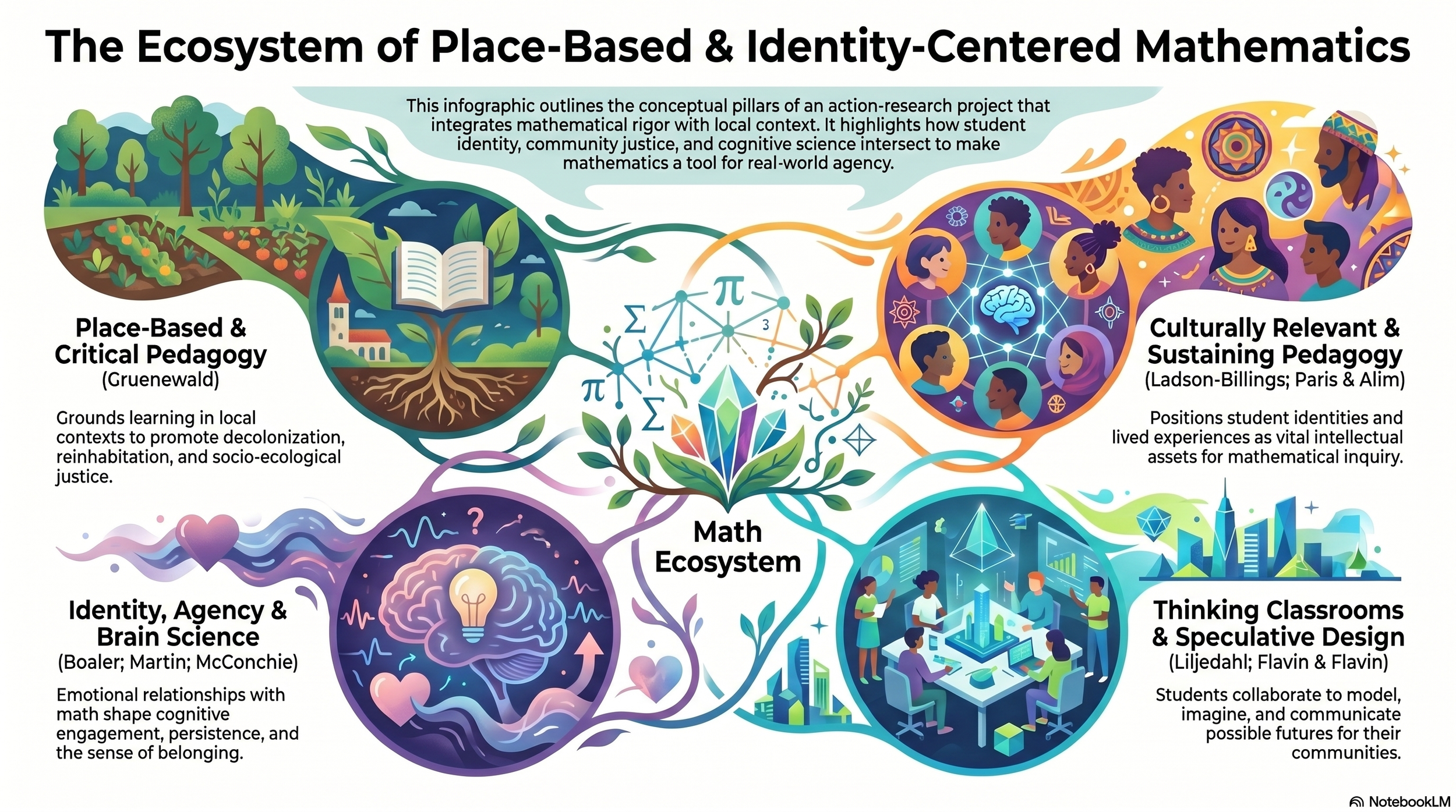
Conceptual Framework
This action-research project and curriculum study is informed by the following frameworks:
Place-Based Mathematics Education grounds mathematical learning in local contexts and community questions (Gruenewald, 2003).
Critical Pedagogy of Place connects education to decolonization, reinhabitation, and socio-ecological justice (Gruenewald, 2003).
Culturally Relevant and Sustaining Pedagogy treats students’ identities, communities, and lived experiences as intellectual assets (Ladson-Billings, 1995; Paris, 2012; Paris & Alim, 2017).
Mathematical Identity, Belonging, and Agency focuses on how students come to see themselves as capable mathematical thinkers whose ideas matter (Barbieri & Miller-Cotto, 2021; Boaler, 2016; Good et al., 2012; Martin, 2009).
Speculative Design and Mathematical Modeling positions students as designers who can use mathematics to imagine, model, and communicate possible futures for their communities (Flavin & Flavin, 2025).
Brain-Science Math Identity Research emphasizes that students’ emotional relationship with mathematics shapes their cognitive engagement, confidence, persistence, and willingness to participate (McConchie, 2026).
Building Thinking Classrooms supports collaboration, discourse, risk-taking, and visible mathematical reasoning (Liljedahl, 2020).
Together, these frameworks support the central claim of this project: rigorous mathematics becomes more powerful when students use it to investigate real questions connected to their lives, their communities, and the futures they imagine.
Analysis and Scholarship
-
This paper explores how a place-based, justice-oriented mathematics curriculum can strengthen gifted students’ identity, belonging, and agency by connecting rigorous mathematical learning to the real planning challenges of Orange, New Jersey. Review the Autobiography of an Idea.
-
This paper examines how critical pedagogy, place-based learning, and neuroscience can reframe mathematics as a tool for identity, belonging, civic participation, and community change. It argues that rigorous mathematics becomes more powerful when connected to students’ lived experiences, local issues, and opportunities to shape a more just future. Review the Conceptual Analysis.
-
This paper traces the evolution of Place-Based Mathematics Education from its environmental roots to its contemporary role in justice-oriented, sustainability-centered STEM learning. It examines how mathematics can move beyond abstraction to become a tool for belonging, civic engagement, and community problem solving. Review the Historical Analysis.