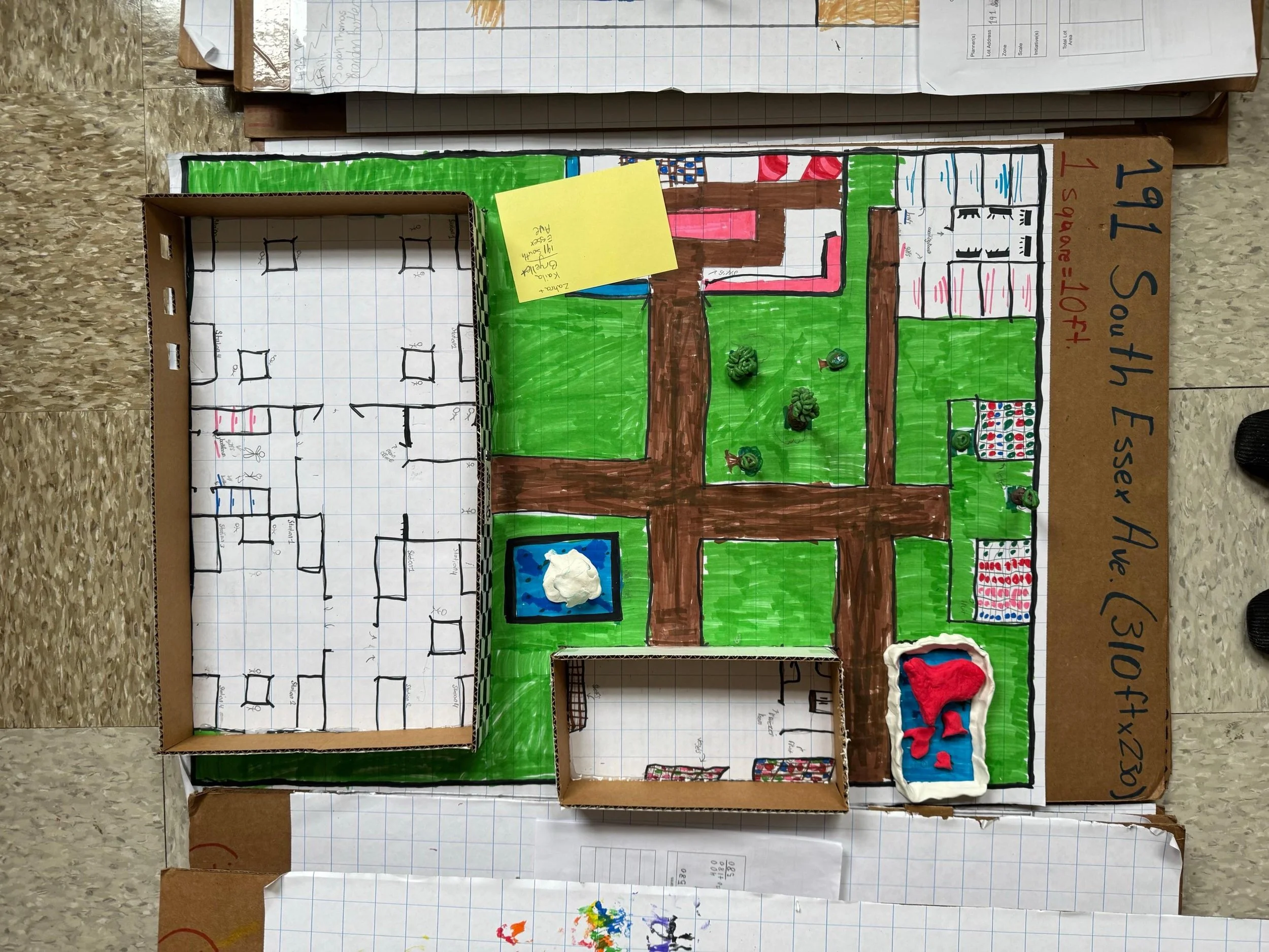
The Implications
“The beautiful risk of education is that it can never be reduced to a process of producing predetermined outcomes.”
— Gert Biesta (2013)
Implications for Educators
This action-research project suggests that place-based mathematics can offer a powerful model for equitable gifted education. When students are invited to investigate real community questions, mathematical rigor does not disappear. It deepens. Students must reason, measure, model, justify, critique, revise, and communicate. They must connect mathematical tools to human consequences.
For gifted learners, this matters because advanced mathematics should not be limited to acceleration or procedural complexity. It should also include depth, relevance, creativity, collaboration, authentic problem-solving, and belonging. This project suggests that rigorous mathematics can be both intellectually demanding and identity-affirming.
What This Study Suggests
This curriculum study suggests that place-based mathematics can strengthen students’ mathematical identity, increase engagement and persistence, support student agency and civic reasoning, position students as researchers and designers, make mathematics feel purposeful and consequential, and expand what counts as rigor in gifted education.
It also suggests that belonging and emotional connection should be understood as part of mathematical rigor. If students’ emotional relationship with mathematics shapes their cognitive relationship with mathematics, then curriculum design must attend to how students experience mathematics, not only what content they complete. Place-based mathematics offers one way to do this because it creates opportunities for students to see themselves, their communities, and their possible futures within mathematical work.
By connecting mathematics to Orange, students were able to see that mathematical thinking already exists in the questions, tensions, and possibilities of their own community.
What Educators Can Adapt
Educators interested in adapting this work do not need to replicate Orange’s exact context. Instead, they can begin with the same design principles.
Start with a local question that matters. Invite students to investigate their own community. Use student voice to shape the direction of inquiry. Build mathematical tasks around real data, space, scale, and constraints. Create opportunities for students to revise and defend their reasoning. Invite an authentic audience to respond to student work. Use reflections and artifacts as evidence of mathematical learning, identity development, belonging, and agency.
Limitations and Next Steps
This project took place in one gifted sixth-grade mathematics classroom, so the findings are interpretive rather than generalizable. The purpose of the inquiry was to study learning within a specific context and to reflect on how the curriculum shaped student identity, engagement, agency, belonging, and civic reasoning.
Future iterations could include a longer implementation timeline, additional student interviews, more systematic comparison of student work over time, and opportunities for students to engage directly with additional community partners. The curriculum could also be adapted across grade levels or used in interdisciplinary collaborations involving mathematics, science, social studies, technology, and design.
Closing Reflection
Mathematical Worldmaking began with a problem of practice, but it became a study of possibility. When students used mathematics to investigate Orange, they were not only learning standards. They were learning to ask better questions, make evidence-based decisions, and imagine themselves as people who can contribute to the places they inhabit.
This project suggests that mathematics can become more than a subject students complete. It can become a language for belonging, a tool for civic reasoning, and a practice of imagining what could be.