Curriculum Study
This interdisciplinary unit brings together mathematics and science in a dynamic, learning block where students engage in authentic, real-world problem solving. The work begins with asset mapping and problem-finding, as students explore Orange, New Jersey to identify both community strengths and areas for growth.
“Place-based educators do not dismiss the importance of content and skills, but argue that the study of places can help increase student engagement and understanding.”
— Gruenewald (2003)
Curriculum Study
Reimagining a More Sustainable Orange was the instructional response to the problem of practice. The curriculum invited gifted sixth-grade students to use mathematics to investigate Orange, New Jersey and design community-centered proposals for a greener, cleaner, healthier, and safer city.
The curriculum was intentionally designed to move students from identity and community inquiry toward mathematical analysis, design, and public presentation. Students worked as researchers, designers, mathematicians, and civic thinkers. Across the unit, they used data, measurement, scale, proportional reasoning, geometry, spatial reasoning, and design constraints to develop proposals grounded in both mathematical evidence and community need.
Sessions 1-2: Launch and Baseline Reflections
Students began by reflecting on their mathematical identities, their relationship to Orange, and their beliefs about whether mathematics could be used to understand and improve a community. These opening experiences established student voice as central to the curriculum.
Sessions 3-12: Research, Data, Mapping, and Design
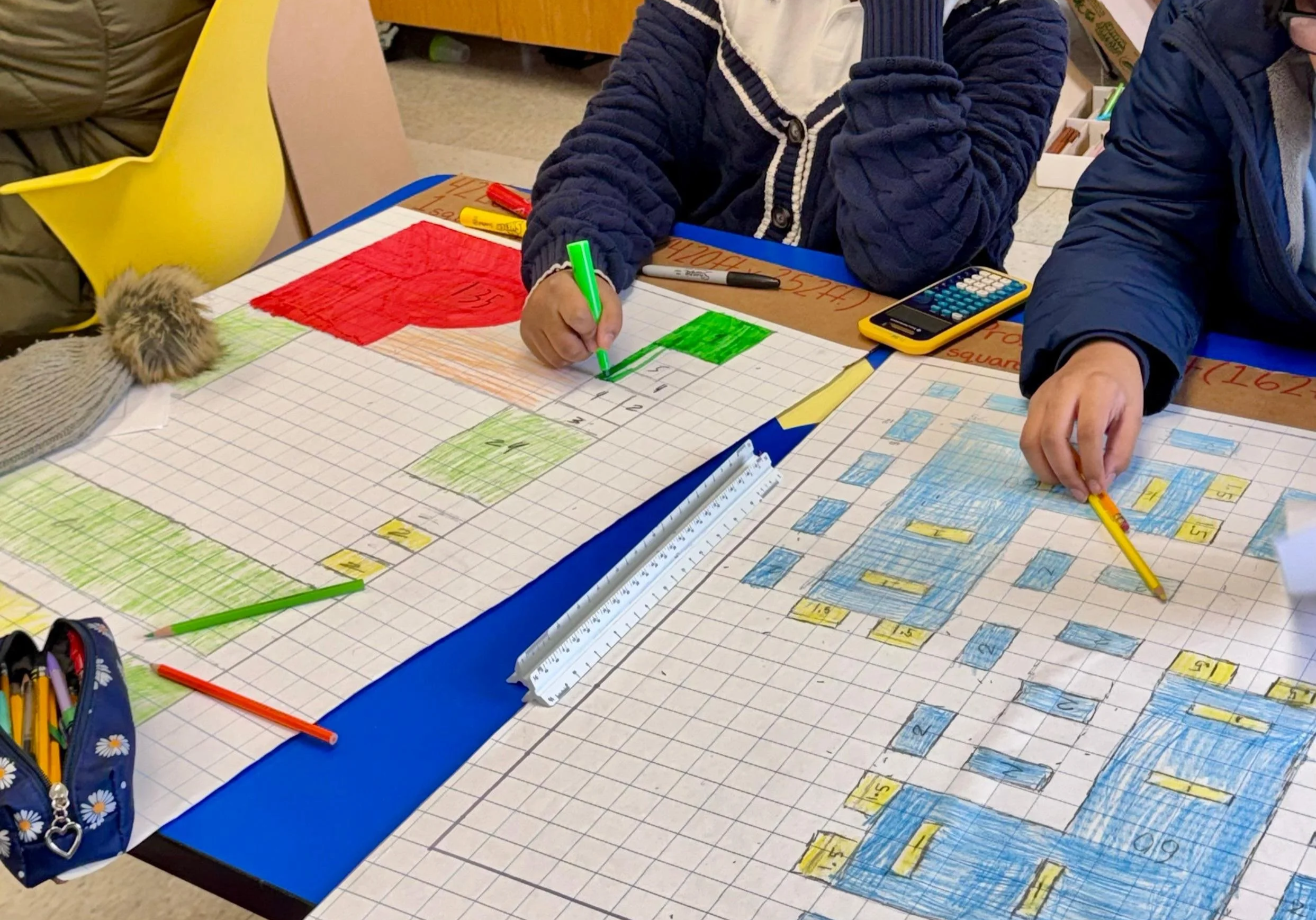
Students studied community priorities, created and analyzed survey data, examined planning areas, decomposed maps, worked with scale and proportional reasoning, and developed design ideas. They used mathematics to make decisions about space, feasibility, and impact.
Sessions 13-15: Model Construction and Presentations
Students refined their proposals, created 2D and 3D models, prepared explanations of their mathematical reasoning, and presented their work to an authentic audience.
Session 16: Reflection and Synthesis
Students reflected on what they learned about mathematics, collaboration, community, and themselves as mathematical thinkers.
Unit Arc
What Students Did
Students worked in collaborative design teams connected to Orange’s planning areas and the citywide goals of becoming greener, cleaner, healthier, and safer. Each team investigated community needs, interpreted survey results, analyzed space, and designed an improvement proposal.
Their work included asset mapping and community observation, student-designed survey questions, data collection and interpretation, map analysis and area decomposition, scale factor and proportional reasoning, 2D blueprinting and 3D modeling, feasibility planning, and public presentation and defense of design choices.
Through this process, students experienced mathematics as more than a set of procedures. They used mathematics to test ideas, revise plans, justify decisions, and communicate possibilities.
The Math
The curriculum was grounded in the Common Core State Standards for Mathematics and the Standards for Mathematical Practice, especially SMP 1: making sense of problems and persevering in solving them. Students applied mathematical concepts within authentic constraints, including land use, area, proportion, scale, data, and design.
Core mathematical ideas included ratios and proportional relationships, measurement and unit conversion, scale drawings and scale models, area and spatial reasoning, data analysis and interpretation, geometry and design constraints, mathematical modeling, justification, and critique.
Instruction was adapted for gifted learners through interviews with experts, open-ended tasks, opportunities for depth and complexity, student choice, collaboration, independent reasoning, and authentic audience feedback.
Student Voice As A Curriculum Driver
Student voice shaped the direction of the curriculum. After studying statistical questions, students collaborated in role groups to design a community-needs survey organized around four priorities: greener, healthier, cleaner, and safer. The survey helped students gather local perspectives and use community data as a foundation for their proposals.
In this way, student voice was not an add-on. It functioned as both a source of curriculum design and a source of evidence. Students’ questions, concerns, data interpretations, and design decisions shaped what the curriculum became.
Belonging Through Design
Belonging was intentionally cultivated through the structure of the curriculum. Students were invited to bring their identities, local knowledge, questions, and concerns into the mathematical work. They were not only solving problems designed by someone else. They were identifying community needs, analyzing data, proposing design solutions, and defending their choices to an authentic audience.
This structure aligns with Flavin and Flavin’s work on speculative design and mathematical modeling. By imagining possible futures for Orange, students used mathematics as both an analytic and creative tool. They experienced mathematics as a way to study what exists, question what could be improved, and model what might become possible.
Student Work Gallery
This gallery showcases student work from across the project, highlighting the progression from early ideas to fully developed proposals. Through sketches, data visualizations, 2D plans, and 3D models, students communicated their thinking, tested possibilities, and refined their designs. Each artifact reflects the integration of mathematics, creativity, and community-centered problem solving, making student thinking visible and meaningful.