The Problem
What happens when gifted mathematics is rigorous, but not yet relevant to students’ identities, communities, and civic lives?
“Place + People = Politics.”
– Williams, quoted in Gruenewald (2003)
The Problem of Practice
This project began with a classroom-based problem of practice: advanced mathematics instruction can still feel disconnected from students’ identities, lived experiences, communities, and civic realities. In many gifted mathematics settings, rigor is often associated with acceleration, abstraction, procedural fluency, and coverage. While these forms of rigor have value, they do not always create opportunities for students to experience mathematics as meaningful, humanizing, or connected to who they are becoming as learners and community members.
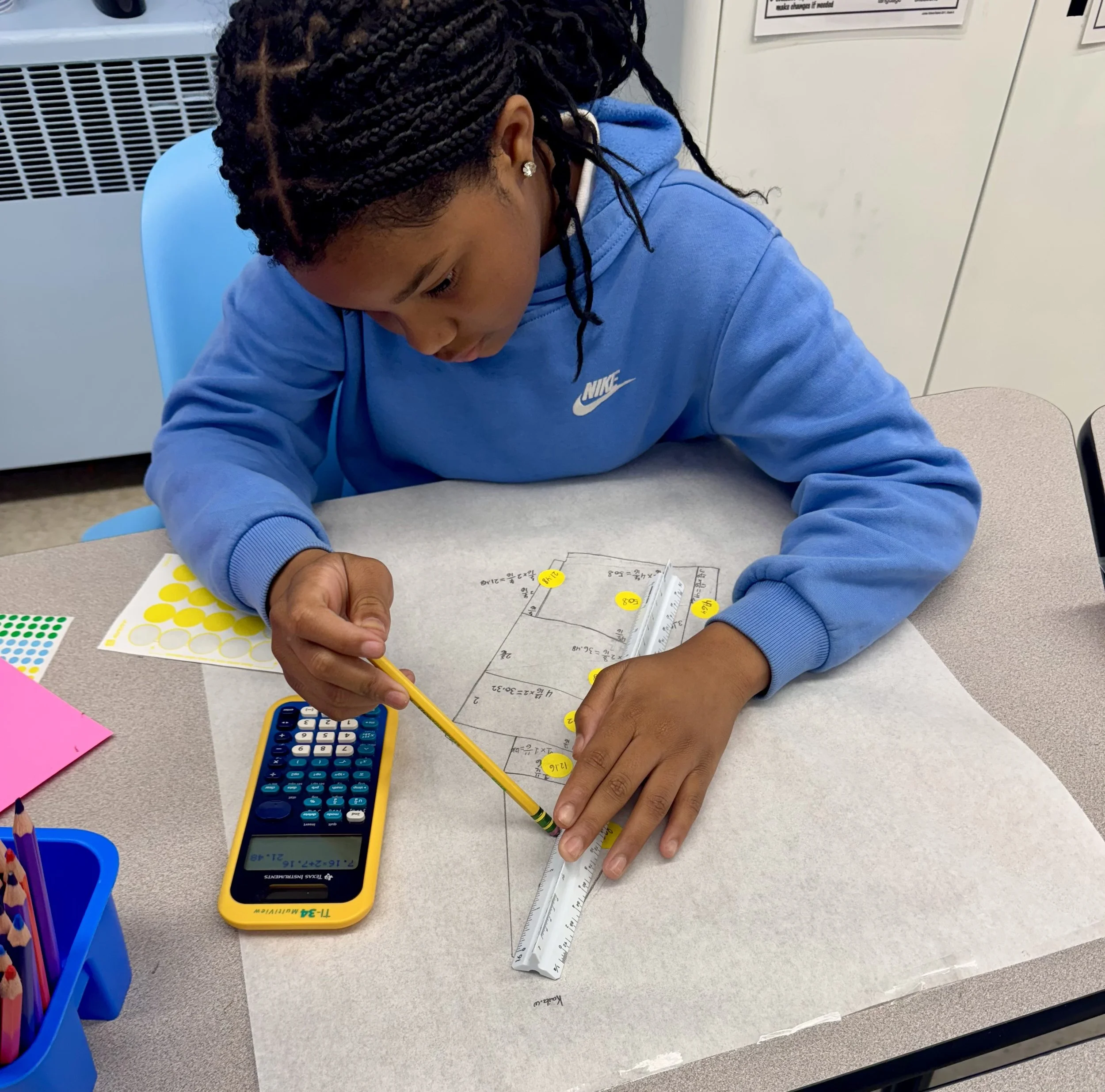
In response, I developed a place-based mathematics curriculum that asked students to use mathematics to investigate real questions connected to Orange, New Jersey. The curriculum was not designed first as a finished product. It emerged from a teacher-research question about what might happen if students were invited to use mathematics to study, question, and redesign the city they call home.
Why Orange?
Orange, New Jersey was not simply the setting for this curriculum. It was the intellectual and civic context for the work. Students live, learn, travel, play, and imagine their futures within the systems and spaces of the city. By grounding mathematics in Orange, the curriculum treated students’ community knowledge as a legitimate starting point for rigorous inquiry.
The city’s planning areas, redevelopment conversations, and goals related to becoming greener, cleaner, healthier, and safer created authentic opportunities for students to use mathematical reasoning. Students were not asked to solve fictional textbook scenarios. They were invited to examine questions that already mattered in their community: How should land be used? What does a sustainable space require? How can data help us understand community needs? What tradeoffs are involved in designing for people, place, and possibility?
The relevance of this work was heightened by ongoing public conversation in Orange about redevelopment, housing, density, and neighborhood change. Rather than treating mathematics as separate from civic life, students used data, measurement, and design to explore the same kinds of questions adults in their community were already asking.
Rigor, Relevance, and Equity
This project responds to a broader concern in gifted education. Students in Title I urban schools may be offered accelerated or advanced content while still receiving limited opportunities for authentic application, identity affirmation, belonging, and community-connected problem solving. When rigor is defined only by speed, abstraction, or procedural complexity, students may not have enough opportunities to see mathematics as a tool for meaning-making, civic participation, and agency.
In Mathematical Worldmaking, rigor is understood differently. Rigor includes sustained reasoning, collaboration, justification, critique, mathematical modeling, design revision, public communication, and emotional investment in meaningful work. Students were expected to use mathematics deeply, not simply quickly. They used data, measurement, scale, geometry, proportional reasoning, and design constraints to develop proposals that were both mathematically grounded and community-centered.
This approach also responds to research on mathematical belonging. Flavin and Flavin (2025), drawing on Good et al. (2012), define belonging in mathematics as feeling accepted and valued in the field. They also note that many students lack this feeling because of limited representation in curricula and school cultures, citing Barbieri and Miller-Cotto (2021). This project was designed to address that gap by inviting students to see their community, their questions, and their ideas as central to mathematical work.